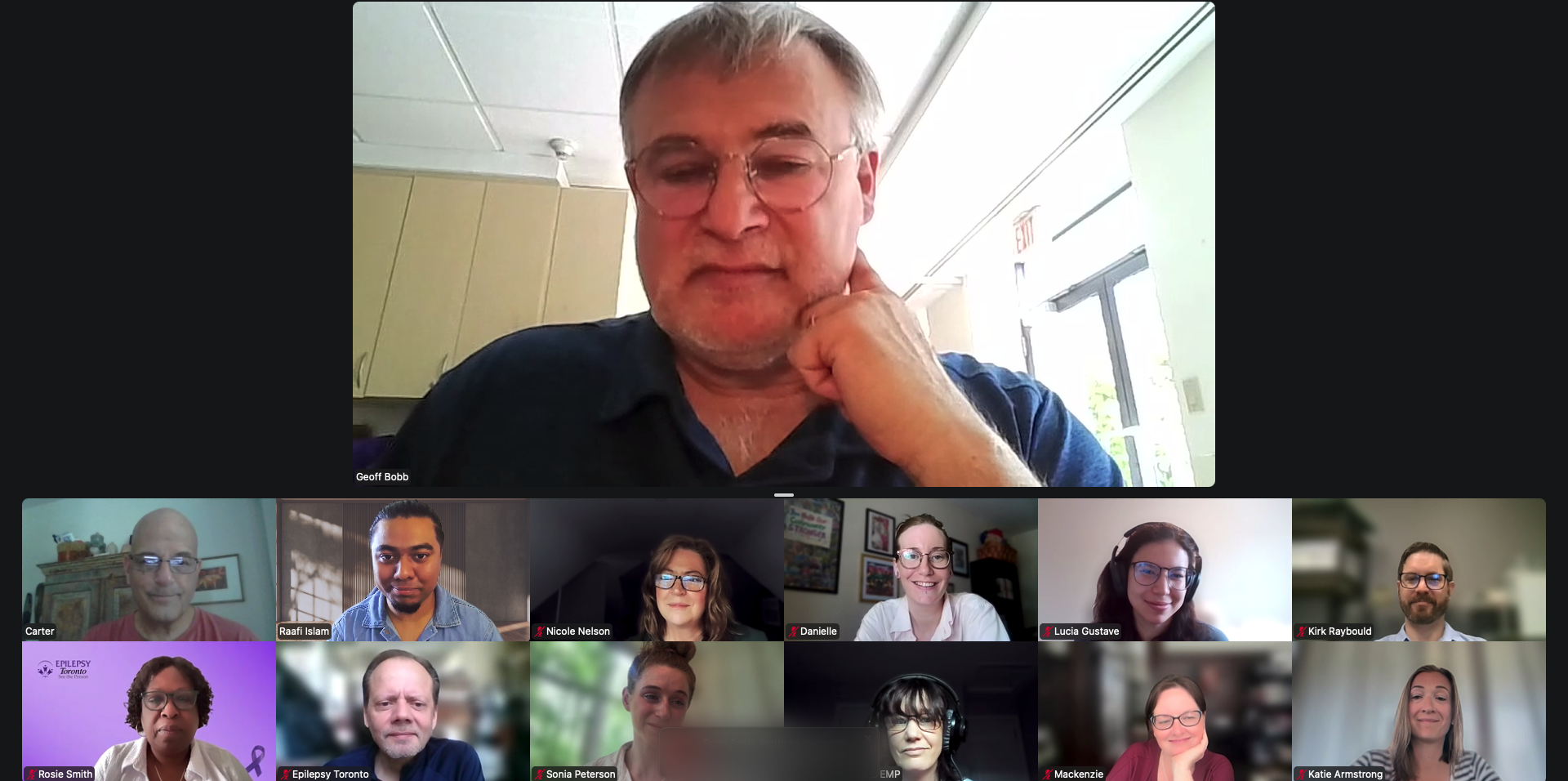
MRP Thesis Defense
REMEMBR
Building an accessible journaling application, built without a programming background.
Raafi Islam Master of Digital Media · Toronto Metropolitan University
Dhaka, 2018
I recognized the face.I couldn't place the name.
The interaction was brief and uncomfortable. I made my excuses and left. What stayed with me was not the moment itself. It was realizing I had no way back to that person: no record of how I knew them, who introduced us, or what we had talked about.
A Recurring Pattern
It did not happen once.
It kept happening, until I started avoiding situations where it might come up again.
Epilepsy
Affects memory encoding directly. My own diagnosis, and the reason this pattern was not random.
Monthly support sessions
The same frustration, from other people, again and again. Existing tools are not built for how memory works when it is unreliable.
The Gap
Calendars store names. They do not store the reason you'd remember someone.
REMEMBR grew out of that gap: a journaling application that organizes entries around people rather than dates, and surfaces them through any connected context. A shared location. A mutual contact. An event.
Research Questions
Two questions drive this MRP
- RQ1
How can a non-programmer use generative AI to design and build a functional software application, and what specific competencies does that process require?
- RQ2
What are the practical limits, recurring failure modes, and design trade-offs of AI as the primary development tool, and how were they navigated?
Thesis
Generative AI has created a genuinely new pathway for non-programmers to build production-grade software. It is not frictionless.
It demands a distinct skill set, rooted in design, editorial, and project-management practice, not programming. The skills are real. So are the limits.
01
Methodology and Positionality
How this MRP was studied: the evidence it draws on, and what first-person, practice-based research can and cannot claim.
Evidence Base
Two kinds of primary evidence
AI conversation transcripts
ChatGPT sessions, October 2025 to April 2026, plus nine Claude Code session transcripts, April to June 2026: the full sequence of directives, AI responses, and corrections.
Versioned application files
Two distinct versioning sequences: fifteen named files from the early build, and a separate series from the first five days of the Claude Code phase.
Positionality
Designer, director, and subject
I did not begin with a research framework. The process was driven by personal experience and iterative making: trying things, observing what happened. This resembles what design researchers call research through practice (Frayling, 1993): knowledge generated by the act of making, not by observing from outside it.
What this makes possible
Access to design intent no external observer could reconstruct. I knew, at every moment, what gap existed between the output and the goal.
What it cannot guarantee
Full objectivity about my own experience, addressed by grounding claims in dated transcripts, not memory alone.
Limitations
What this study cannot claim
A single case
This cannot produce statistical claims about non-programmer AI-assisted development as a general phenomenon.
No external verification
Findings are corroborated against dated transcripts, but the interpretation of that evidence remains mine.
Theory found after the fact
The Actor-Network Theory connection was recognized in retrospect, not tested as a hypothesis.
What it can produce: a detailed, internally consistent account of one instance of this process, precise enough to generate propositions later research can test.
02
REMEMBR
The artifact this MRP produced, and the accessibility logic behind every decision in it.
The Artifact
A people-first journal, not a dated diary
Users build profiles for the people in their lives, linked to places, events, and shared contacts. Remember any one connected thing, and you should be able to find the person.
Built for
Epilepsy · Prosopagnosia · Traumatic brain injury · ADHD
- 8 months
- Oct 2025, Jun 2026
- 13,000+
- Lines. Single-file HTML, CSS, JS
- 0
- Lines written by hand
Design Principle
Accessibility is the baseline, not a feature
Governed throughout by WCAG 2.1 AA, Ontario's AODA, and W3C COGA guidance for cognitive accessibility. Every setting in this panel is user-controlled, not auto-detected.
- Perceivable
- Atkinson Hyperlegible type. A five-phase color journey ending in verified AA-contrast sky-teal.
- Operable
- 44 by 44 pixel touch targets, reduced-motion setting, no photosensitive strobing.
- Understandable
- Easy Mode: one plain-language question at a time, full feature parity.
- Robust
- ARIA labeling, full keyboard navigation, screen-reader optimization.
Signature Feature
The Connection Web
A force-directed graph where people, places, memories, and events are equally weighted nodes. Enter from any point, a mutual friend, an event, and trace outward to the person you are trying to reach.
Structurally resonant with Actor-Network Theory (Latour, 2005): a connection recognized only in retrospect, after the interface was already built from lived experience rather than from theory.
Signature Features
Two more ways in
Associative Search
One field searches every content type at once, without category pre-selection: matching how episodic memory is actually retrieved (Tulving and Thomson, 1973).
Easy Mode
App-wide progressive disclosure. Every multi-field form becomes a one-question wizard, grounded in cognitive load theory (Sweller, 1988), without reducing functionality.
Signature Features
Designed to remove friction, not add polish
Avatar Creator
For users without photos of everyone they track. Reference standard: Snapchat's Bitmoji. Three rejected rounds before the fourth met the bar.
Social Card Generator
A canvas-based, shareable card acknowledging someone's place in the user's life. "I REMEMBR YOU."
03
Findings
What eight months of session transcripts and versioned files reveal about this development model.
Finding 1 of 3
Four competencies, not one line of code
- 01
Specification
Translating design intent into language precise enough for the AI to act on correctly: a continuous discipline, not a single act.
- 02
Evaluation
Judging whether an output meets the standard without reading the code, using behavior, comparison, and testing as proxy signals.
- 03
Direction
Corrective instruction specific enough to close the gap. Naming a reference product outperforms "make it better."
- 04
Continuity Management
Holding a coherent product vision across sessions with a tool that retains nothing between conversations.
Finding 2 of 3
Four failure modes, recurring by structure
- 01
Silent Feature Regression
Confirmed features vanished between sessions with no warning. The AI worked from immediate context, not a persistent inventory.
- 02
Persistent Hallucination
The same factual errors recurred across sessions, for example claiming local-only storage, when REMEMBR uses hybrid cloud sync.
- 03
Token Limit Constraints
Productive windows cut to 15 to 20 minutes before context exhausted; resets could take up to five hours.
- 04
Code Token Exhaustion
At 13,000+ lines, loading the file alone consumed a large share of the context window before any new work began.
Finding 3 of 3
Three practices developed in response
- 01
Structured Context Documents
Dense, machine-readable briefings, 1,200 to 3,500 words, pasted at the start of every session to compensate for zero persistent memory.
- 02
Standing Rules
Every recurring AI error converted into a permanent, explicit constraint carried into every future session: never re-explained, always enforced.
- 03
Forced Review and Planning Cycles
Mandatory token wait periods became a built-in cycle to test live updates, find bugs, and plan the next session on paper.
A Question This Raises
Who owns this, and is the data safe?
REMEMBR handles sensitive personal memories about real people. Ownership and data governance were design requirements from the outset, not an afterthought.
Code ownership
AI outputs directed through sustained human creative choice qualify for copyright protection. Anthropic does not claim ownership over generated code (Anthropic, 2024; U.S. Copyright Office, 2023).
Training data exposure
Development sessions were run with training opt-out enabled. Design decisions and architecture were never exposed to the public model.
Platform choice
Rork was abandoned in part because its free tier made project data public. REMEMBR runs on infrastructure I own and can audit.
Discussion
Answering both research questions
- RQ1
A non-programmer can build production-grade software by developing four specific competencies: design and editorial skills, not programming ones, already held by a population far larger than the one that currently builds software.
- RQ2
The limits cluster into four failure modes, all expressions of one root cause: a stateless tool operating on an incomplete picture of what it has already built. These are manageable through documented, repeatable practice.
Contribution and Next Steps
What this case adds, and where it goes
To the literature
A four-competency taxonomy precise enough to be tested, and a context-document practice that answers the multi-session, stateless-tool problem the existing literature does not engage with.
What comes next
Continued development on the same methodology. User testing beyond the researcher's own account. Production release beyond closed testing.
Ko et al. (2011) named the persistent gap between the people who need software and the people who can build it. REMEMBR is a direct instance of that gap narrowing, not because the technology got smaller, but because the skills it demands are already held by a much larger population than the one that currently builds software.
I REMEMBR YOU
Thank you.
Questions and discussion
Raafi Islam · REMEMBR · Master of Digital Media, Toronto Metropolitan University